Stillwater, OK · Garage Door Service
Agra homes built around 1975 still run original steel rollers on narrow track. Here's what roller replacement actually involves and costs for this area.
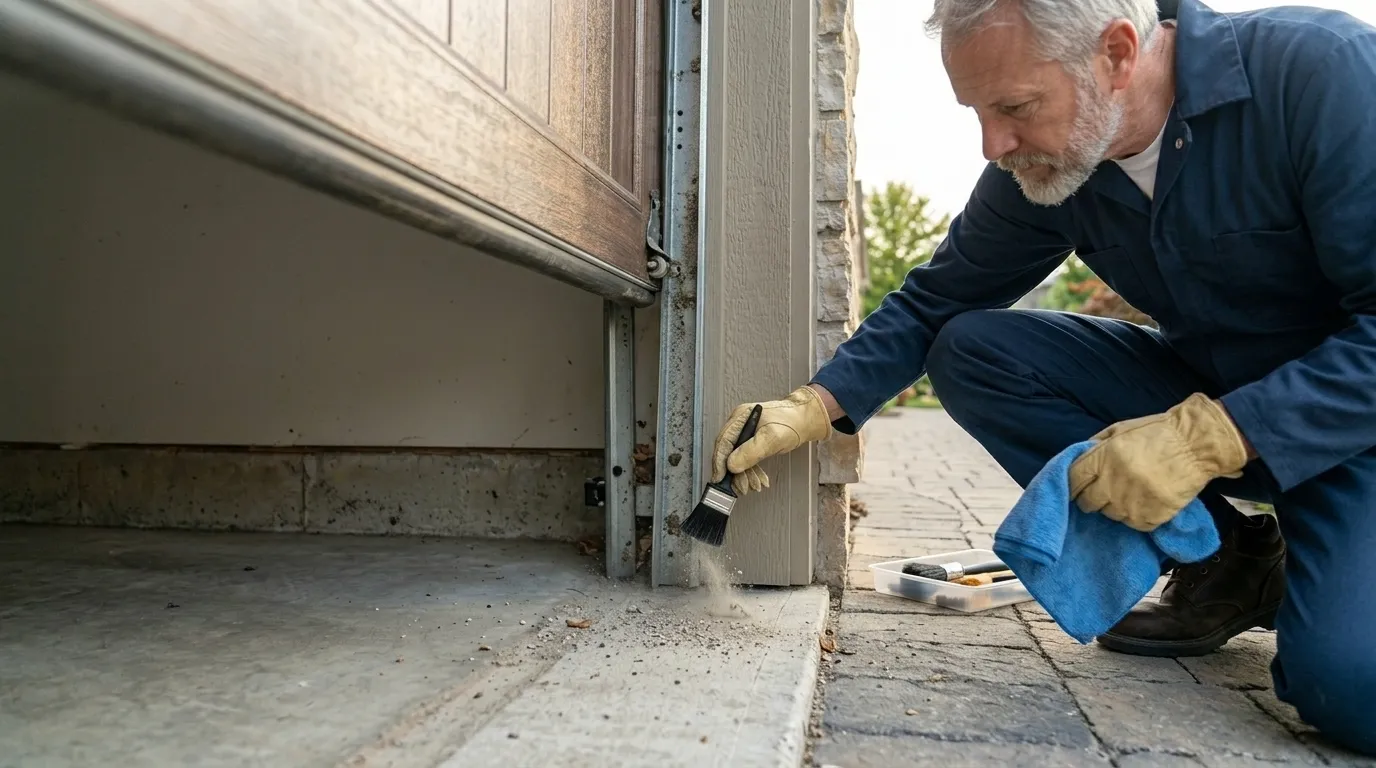
Rollers look like the easiest garage door part to swap yourself, and on a newer door with nylon rollers and a factory track, that's often true. Agra is a different case. Most doors here went in when the house did, and the median build year across this area is 1975 - meaning a lot of the rollers turning in these tracks right now are the original stamped-steel ones, not nylon.
Steel rollers on a track that old don't just pop out. Fifty years of paint, grease buildup, and rust scale can weld a roller stem to its bracket, and the bracket itself may be thinner-gauge than what you'd buy at a hardware store today. Pull one loose without knowing what you're doing and you can bend the track, which turns a $20 part into a full section replacement.
If you're comfortable with a socket set and you've got a single-car door with visible wear on just the bottom two rollers, it's a reasonable weekend job. If the door is heavy, if it's a double, or if you can't tell whether you're looking at the original hardware or a prior repair, that's where we'd rather come look at it before you take the bracket apart.
We don't quote a number here without seeing the door - the range depends on whether you need 4 rollers or all 10, whether the track brackets are still sound, and whether the bearings the rollers ride in have any play in them. Doors from the 1966-1983 era in Agra tend to need more than a straight roller swap, because the roller and the track wear together over that many years, not separately.
What we can say is that a roller-only job, where the track and hinges check out fine, costs less than a job where we're also straightening a bracket or replacing a hinge that's cracked from the same age and use. At a median household income of $43,750 for this area, most people we talk to want the roller job scoped tight - fix what's actually worn, not a full hardware overhaul sold as a roller job. Ask for the breakdown before the work starts, not after.
Agra sits about 20 miles out from our shop in Stillwater, so this isn't a call we fold into a route on short notice - it's a trip we plan for. Once a technician is at the house, roller replacement itself is a short job: on a standard door with accessible track, swapping a full set of rollers usually runs under an hour.
The honest limitation is the travel, not the repair. We're not going to promise a same-hour response for a call this far out, and we won't pretend otherwise. If the door is stuck shut and it's the only way into an attached garage, tell us that up front so we can prioritize the trip - but the roller replacement itself won't be what keeps you waiting.
The job starts with the track, not the rollers. On a door built when this area's housing stock went in, the track brackets are often held with lag screws into jamb wood that's shrunk and moved over the decades, so before any roller comes out, we check whether the track is still running straight and square to the door.
With the track confirmed, we release tension carefully - the bottom rollers carry cable and spring load even on a door that's not moving - then pull each roller and its stem. Steel rollers come out as one worn piece; if the stem is rusted into the bracket, that bracket gets attention too, since forcing it risks bending the rail. New rollers go in, usually nylon with sealed bearings, since they run quieter and don't need the periodic oiling steel ones do.
Last step is running the door through a full cycle by hand before we power it, checking for binding at every panel hinge, not just the rollers we replaced. On a door this old, a roller problem rarely shows up completely alone.
The failure we see most in this area isn't the roller itself - it's what the roller was hiding. Fifty years of a worn roller dragging in a track wears a groove into the rail that a new roller won't fix on its own; the door still binds because the track, not the roller, is out of shape.
Cold makes this worse. In a moderate-cold climate like this one, steel rollers that have been squealing all winter often aren't just dry - they're starting to crack at the stem from repeated freeze-thaw flexing, and a roller in that state can shed mid-cycle rather than just wear out gradually. That's not a dramatic failure, but it is one that turns a planned roller swap into an on-the-spot track inspection and, sometimes, a same-day decision on whether to replace a bent section instead of just cleaning it up. We'd rather tell you that up front than swap rollers and have you call back in a month.
If your house went up around the area's median year of 1975, there's a decent chance at least some rollers are original steel, especially if no one has mentioned replacing them. Original steel rollers on a house this age are usually worn enough to be noisy, even if they haven't failed outright.
We stock common roller sizes for the door ages typical to this area's 1966-1983 housing stock, but we can't promise every bracket or hinge variant is on hand for a trip 20 miles from Stillwater. If the job turns up something unusual once we're on site, we'll tell you before ordering it.
Sometimes, but not always. If the track has a worn groove from years of a bad roller dragging through it, the door can still bind after new rollers go in. We check the track condition as part of the job, not as an upsell after the fact.
We don't promise a set response time for a call this far from our Stillwater shop - it's a trip we plan rather than fit in on short notice. If the door is stuck and it's your only garage access, let us know so we can prioritize scheduling the trip.
Call or request a quote - tell us what your door is doing and where you are.
